10 minutes to first proof candidate: your agent uses your PR history.
Start in one repo, extract the first team rule locally, wire your local AI CLI through MCP, then preview one trusted fix and inspect proof setup.
difflore turns merged PR reviews into source-linked team rules your coding agent reads while editing — and after the cold start, the corrections you make in live agent sessions keep the rule set growing. The first-run path is built around evidence, not setup theatre: one local import, one recall path, one patch preview, one dashboard with receipts when you choose Cloud.
Use this as a repo-shaped starting point, then replace it with the GitHub repository you choose during install.
The 10-minute proof-candidate path
Five concrete checkpoints, one repo, one terminal. You end with a remembered review pattern previewed against code.
- 01
Import review history locally
2 minInstall on one repo, then import the first 50 merged PR reviews locally so difflore can extract rules before anything needs to be uploaded.
$difflore import-reviews --max-prs 50 - 02
Extract the first rules
3 minWatch source-linked rule candidates surface from real review comments — what your team rejects, prefers, and repeats — then approve the ones worth keeping.
$difflore rules - 03
Wire local AI CLI / MCP
1 minRegister difflore with Cursor, Claude Code, Codex CLI, Gemini CLI, or any MCP-compatible agent.
$difflore init --agents - 04
Run one real fix
3 minPoint difflore at a real working-tree diff and preview a patch grounded in the rules it just learned — see the rule fire on exactly the code it should.
$difflore fix --preview - 05
See Impact
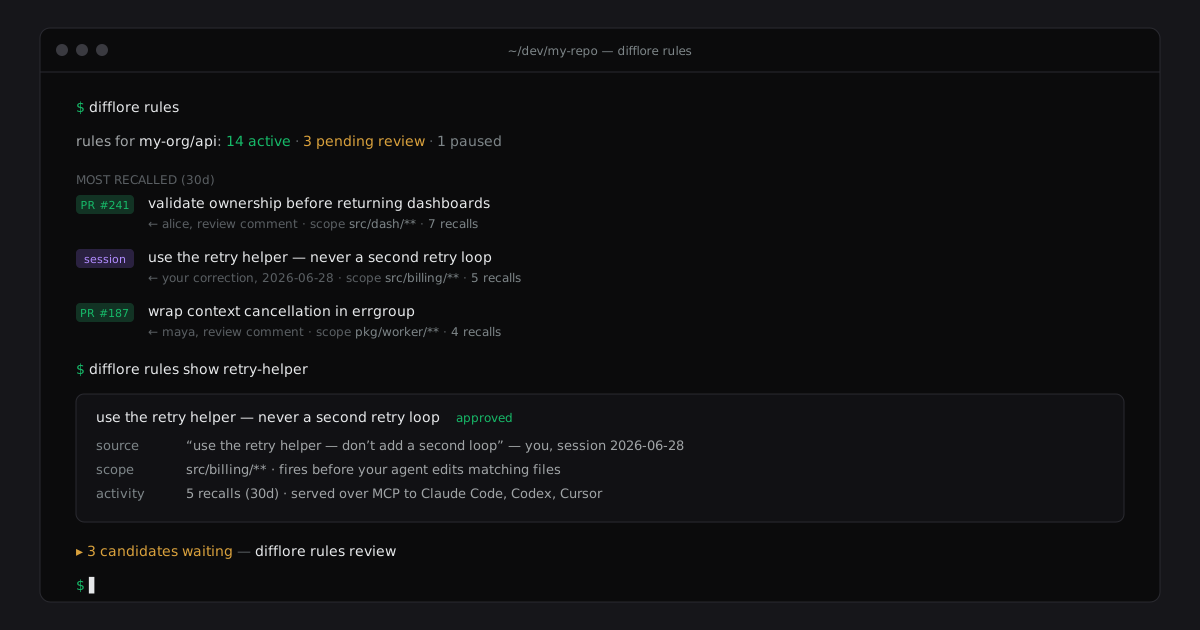
1 minOpen the impact surface: imported rules, coverage, and agent recalls — each with source-linked evidence.
$difflore impact
Then run one real fix and open proof. The full five-step path is shown on larger screens.
Open source. Local-first. Built for the agents you already use.
Rules stay on your machine unless you explicitly connect cloud sync.
Install the MCP server, then import PR comments
Local-first. Follow the install guide for local setup; add Cloud when the team needs shared rule approvals.
# 1. install (Rust toolchain, ~45s cold compile)
$ curl -fsSL https://difflore.dev/install.sh | sh

# 2. initialize repo + agent integrations
$ cd your-repo && difflore init
 ✓ provider configured · agents detected · personal rules ready

# 3. import review history locally
$ difflore import-reviews --max-prs 50
 → source-linked rules extracted locally; upload only when you choose Cloud sync

# 4. review + approve rules in the terminal
$ difflore rules
 ● origin-colored rule list, source links, next command suggested

# Optional: connect Cloud when you want team sync
$ difflore cloud login
 ✓ device connected for sync and proof receipts
Questions people ask before signing up
Straight answers. No marketing dodges.
The core CLI runs locally - indexing, retrieval, and rule injection happen on your machine against a local SQLite index. Cloud is optional and only stores what you explicitly sync: extracted rules, PR review metadata, and recall signals. Raw source files are never uploaded.
No. Local work lives in the OSS CLI: difflore status shows your overview and next step, and difflore rules is where you review and approve rules - all in your shell. The web dashboard is for team collaboration only.
About 60 seconds. Install difflore, run init in your repo, register MCP with every detected agent, then open the terminal dashboard. GitHub PR history backfills after you install the cloud app.
12 AI coding tools out of the box: Claude Code, Codex, Cursor, Gemini CLI, Windsurf, Goose, OpenCode, Copilot CLI, Crush, Roo Code, Warp, and Antigravity. Any MCP-compatible agent can connect.
Those are static hand-written documents. difflore extracts rules from your actual review history and keeps them current as your team's standards evolve.
Everything your LLM can read. difflore's search is language-agnostic and works on TypeScript, Rust, Python, Go, Swift, and Kotlin codebases out of the box.
The local runtime is free. Cloud pricing is based on the team system of record: hosted rule capacity, the approval workflow, evidence-chain provenance, Reviewer Context distribution, the CI gate, and support. BYOK is available for teams that want their own model provider. Current Free OSS, Starter, Growth, Team, and Enterprise terms are shown on /pricing.
Your agent reads your PR history tonight.
The open-source local runtime is free forever. Cloud plans add the team system of record: an approval workflow, evidence-chain provenance, Reviewer Context distribution, and a CI gate. Current Free OSS, Starter, Growth, Team, and Enterprise pricing is shown on /pricing.